VIM and AI: Toward Intelligent Invoice Processing

Martin Nooteboom - Senior SAP Invoice Management Consultant
Following up on my colleague Jasper Blok’s blog post about the OpenText VIM Partner Deep Dive, this blog post will take a closer look at AI-related topics. In addition to the topics OpenText had prepared, there was also time for a brainstorming session on potential AI scenarios for Vendor Invoice Management (VIM). This brainstorming session generated many ideas for future developments.
The Evolution of OpenText VIM: From Static Workflows to an AI-Driven Ecosystem
When we look at OpenText’s developments at VIM, we see a shift toward an AI-driven ecosystem in which AI agents work together. VIM is thus evolving from workflow automation to an environment in which AI agents coordinate processes and tasks.
Traditionally, VIM used a static workflow model that presentedexceptions to users for review. In this classic Assisted AI model, algorithms read metadata, but the process is interrupted based on the calculated confidence score. The system then waits for a decision from an employee.
The vision for VIM is a specialized network of AI assistants and autonomous agents that support users at various stages of the process. In this new ecosystem, intelligent agents can communicate, negotiate, and perform tasks independently. This marks a fundamental shift: AI agents handle tasks on their own, while employees can focus more on complex exceptions and situations that require human judgment. These AI agents are integrated into the organizational structure and support employees based on their specific roles. OpenText aims to provide an AI assistant for every role in the process:
This transformation has been outlined in a strategic roadmap consisting of three phases:
Phase 1 - Baseline: focuses on Copilot and Insights, and provides support to employees (human-in-the-loop) and data-driven insights (data intelligence).
Phase 2 - Mid-Curve: introduces autonomous exception handling. Employees still review the results (human-in-the-loop) and can intervene in the event of standard blockages.
Phase 3 - Apex: focuses on an ecosystem capable of operating completely autonomously. AI agents coordinate multiple tasks and processes (multi-agent orchestration) without direct human intervention (human-out-of-the-loop). The goal is zero-touch processing.
Bridging the Data Gap with SAP Joule
A major bottleneck in invoice processing is the “swivel-chair” analysis: employees manually switch between structured data in SAP S/4HANA and unstructured information in documents stored in the OpenText (Core) Archive. This takes time, for example, when employees need to determine the cause of an invoice hold.
To address this, VIM is transforming from a system of record into a system of intelligence by making core functionalities such as reusable AI skills available. SAP Joule serves as the orchestration layer where these VIM skills are deployed. Through ready-to-use Application Programming Interfaces (APIs), VIM provides AI agents with access to the necessary functionalities.
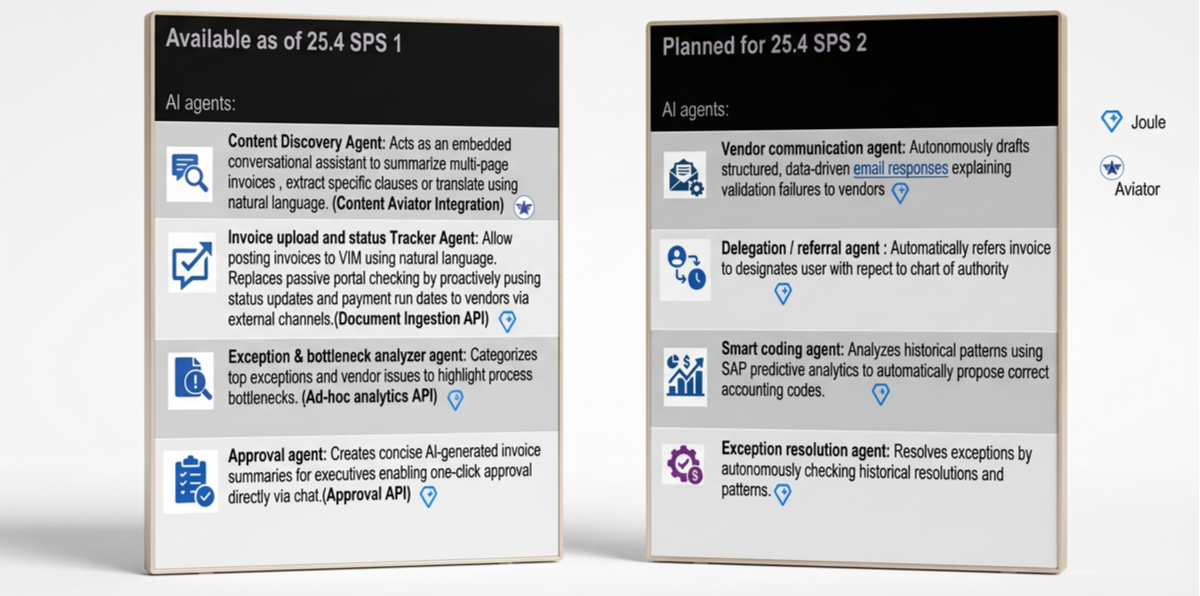
During the session, two examples of AI agents were demonstrated that are already available in combination with Joule:
Content Discovery Agent: a built-in AI assistant that allows users to ask questions about multi-page invoices. The assistant summarizes invoices and extracts relevant clauses from the corresponding contracts.
Approval Agent: generates concise AI-powered summaries of invoices for managers, allowing them to easily approve them with a single click via chat.
In addition, APIs are available for reporting—such as through the Invoice Lifecycle API—as well as for approvals and retrieving user tasks. With these, OpenText is building a catalog of agent skills: ready-to-use APIs that can, for example , be used from within Joule Studio or integrated with Content Aviator.
Improving Document Recognition with Core Capture 26.2
In addition to VIM, OpenText Core Capture for SAP Solutions 26.2 also introduces a GenAI integration. This update improves document data recognition immediately after installation (out of the box). A key new feature is the Intelligent Voter. This feature combines three recognition methods to deliver more accurate results:
Recognition based on a knowledge base (Knowledge Base Recognition).
Adaptive learning, in which the system learns from previous recognitions and corrections.
AI recognition using largelanguage models (LLMs).
With this AI integration, Core Capture can recognizeheader and line item data (header and item fields) from various document types, such as invoices, sales orders, and packing slips. This works with documents from a wide range of countries and in various languages, without requiring additional training.
The main advantages of the new Core Capture engine are:
No specialized knowledge of machine learning or AI is required.
An improved OCR engine better recognizes handwritten and vertical text, as well as low-quality images, such as smartphone photos.
Item descriptions can be recognized as a standard field in various document types. This opens up opportunities for further automation, such as when matching material numbers.
The following developments in document recognition are planned:
Classification of incoming documents, so that different document types can be processed through a single inbox.
Automatic recognition of attachments.
Automatic splitting of documents when necessary, such as when an invoice and an attachment are combined into a single PDF file.
The Future of Invoice Processing: Increasingly Autonomous with AI
By using AI to automatically extract information from documents and combining this with low-code platforms such as Joule Studio, on which organizations can develop their own AI agents, OpenText is taking the next step in process automation. This enables organizations to move toward processes in which AI agents perform an increasing number of tasks independently, while employees remain involved where human judgment is required.
Learn more
If you have any further questions or would like more information on this topic, or if you have other questions regarding SAP Workflow, Fiori, or SAP Invoice Management (SIM), please contact Martijn Wever.
Related posts