From Workflow Automation to Autonomous Processes

Armand Boers - Senior SAP Fiori & Workflow Consultant
AI has been part of SAP's strategy for some time now. With SAP Business AI, Joule, and an increasing amount of AI functionality being integrated into SAP processes, artificial intelligence is becoming an increasingly integral part of day-to-day business operations.
At SAP Sapphire 2026, SAP took the next step with the introduction of the Autonomous Enterprise. The goal is clear: AI will handle an increasing amount of the work, while people set the direction and provide oversight where necessary.
That sounds like a fundamental change. But for organizations that are already using SAP workflows, automation, and process optimization, an interesting question immediately arises: What will actually change?
And perhaps even more importantly: where can this technology add value to existing SAP processes?
In this blog, we'll address four questions:
What is SAP announcing?
What is an Autonomous Enterprise?
What can it do?
What is currently available or has been announced?
1. What is SAP announcing?
From SAP Business AI to the Autonomous Enterprise
SAP positions the Autonomous Enterprise as the next step in enterprise AI. Artificial intelligence should not only provide information or support employees, but also, increasingly, carry out parts of business processes on its own.
To that end, SAP brings together various capabilities within the SAP Business AI Platform. These include Joule, Joule Assistants, Joule Agents, Joule Studio, and the SAP Knowledge Graph.
SAP focuses on various business areas, including Finance, Procurement, Supply Chain, HCM, and Customer Experience.
Figure 1: SAP Sapphire Keynote 2026 - SAP Autonomous Enterprise.jpg
The idea is that agents don't just work within a single application, but can also coordinate tasks across different systems and domains.
What do you need for that?
A large language model possesses a great deal of general knowledge. However, that doesn't mean it knows how a specific organization operates.
For example, an agent who needs to review a purchase order must know which supplier is associated with it, what contractual terms apply, which goods have been received, and what actions are permitted.
An Autonomous Enterprise therefore needs more than just AI:
ERP as the foundation for business processes and transactions
Company Information
Process Knowledge
Reliable Master Data
Governance and Oversight
AI models and agents
That last point is important. For business-critical processes, a high degree of reliability, predictability, and auditability is essential. An agent that independently executes a payment, change, or approval must operate reliably and in a verifiable manner within clearly defined limits.
SAP therefore emphasizes the combination of AI with business context, data, and governance. This also changes the role of AI.
From: “Give me some information.”
To: “Help me with this task.”
Next: “Perform this task.”
And finally: “Make sure this result is achieved.”
The latter is the direction the Autonomous Enterprise is heading. But that doesn't mean process design will disappear.
AI expands the possibilities within the process, but does not automatically take over the process design.
2. What is an Autonomous Enterprise?
To better understand the concept of " autonomous," it helps to look at the evolution from workflows to autonomous processes in stages.
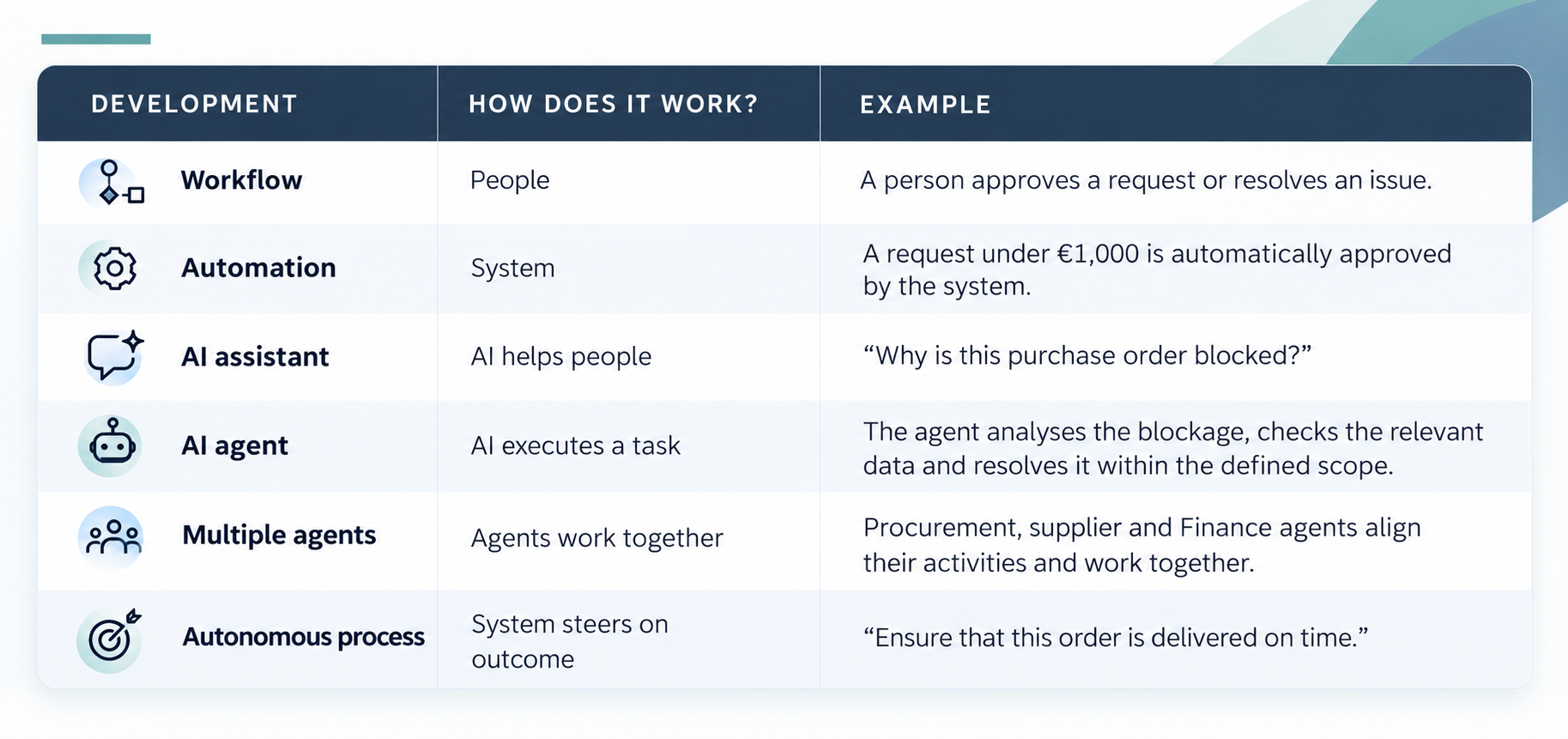
In a traditional workflow, the process steps are designed in advance. With automation, rules are added to them; for example: If the amount is less than €1,000, automatically approve the application.
An AI assistant then helps you understand a situation, for example: “Why was this purchase order blocked?”
An AI agent goes a step further. It can gather information, analyze a situation, determine what action is needed, and carry out that action within certain limits.
When there are multiple agents, different specialized agents can work together.
An autonomous process goes one step further: the focus is not just on the individual task, but on the desired business outcome.
But that doesn't mean workflow will disappear. In fact, a future process will likely consist of a combination of:
Workflow + business rules + AI agents + employees + user interfaces + integrations
Some steps remain entirely predictable and controllable. Other steps, on the other hand, are well-suited for AI because they depend on context, interpretation, or exceptions.
The challenge, therefore, is not: “How do we make everything autonomous?”
But: “Where does autonomy actually add value?”
The Role of the SAP Knowledge Graph
A key component of this development is the SAP Knowledge Graph. An AI model possesses general knowledge. An enterprise agent, however, also requires specific business context.
Which supplier is associated with which purchase order? Which products are associated with which factory? Which contract terms apply? Which user is authorized to perform a specific action?
The Knowledge Graph is designed to make these types of relationships available to AI, so that agents don’t just look at isolated data points but can also leverage the connections between business data and processes. SAP positions this as a key contextual layer within the Business AI Platform.
In simple terms: Business Data → Context → Analysis → Decision → Action
It is precisely that last step that makes autonomous process automation interesting.
Figure 2: SAP Sapphire Keynote 2026 - SAP Knowledge Graph
3. What can it do?
The SAP vision only becomes truly interesting when we look at specific applications.
Process Consulting Agent
One example is the Process Consulting Agent in SAP Signavio. Users can ask questions about business processes using natural language. The agent can analyze process information, identify deviations and inefficiencies, and make recommendations for improvement.
For example: “Where are the biggest inefficiencies in our order-to-cash process?” Or: “Why is the turnaround time for this process increasing?”
This makes process analysis more accessible and can help identify areas for improvement more quickly.
However, this is not yet a fully autonomous process. It primarily involves analysis and advice, not the completely independent implementation of process improvements. The user then decides what to do with the recommendations.
That distinction is important:
Not every AI agent performs actions independently, and not every AI agent makes a process autonomous.
Joule Studio 2.0
With Joule Studio, SAP is taking it a step further. This enables organizations to build their own agents, applications, and workflows. SAP offers both no-code options and options for developers.
In doing so, SAP isn't just saying, "Use our agents," but also, "Build your own agents."
One notable development is the integration with n8n, a platform for workflow automation and integration. This brings together different worlds:
AI agents + workflow automation + integration + SAP processes
But just because it’s easier to build an agent doesn’t mean it results in a good business process. A procurement process still requires authorizations, exceptions, different user groups, and governance.
The question, therefore, is not just, “Can we build an agent?” but above all:
“What task or decision must the agent carry out, within what scope of authority, and how does that agent fit into the overall process?”
4. What's available?
SAP has made agents available or announced them for various business processes.
In this context, it is important to distinguish between support, task automation, autonomous tasks, and truly autonomous processes. It must also be clear which features are already available and which are still on the roadmap.
Invoice processing
Invoice processing is a good example, because traditional automation has been used in this area for many years. A typical process looks like this:
Invoice → Record → Verify → Match → Workflow → Approve → Post → Pay
SAP is adding more and more specialized agents, including:
Invoice Capture & Extraction
Missing Goods Receipts
Invoice Validation & Exception Handling
Payment Terms
Enrichment & Coding
Tax Validation
Fraud Prevention
Contract Matching
For example, the “Invoice Validation and Exception Handling Agent” can analyze an anomaly in an invoice and help determine how to resolve it.
That’s a clear step beyond simply saying, “This invoice has an exception.”
The agent can investigate why the exception occurred and what possible solution there is.
But here, too, the same applies: the agent is just one part of the overall process.
Who has the authority to approve an exception?
What are the tolerance limits?
When is a police officer allowed to act on his or her own initiative?
When is human approval required?
Which workflow is initiated?
How can the user gain insight into the situation?
And how do you check afterward to see if the process worked properly?
These are not minor issues. They play a key role in determining whether AI can be used safely and effectively.
What's on the roadmap?
SAP has announced several agents for upcoming releases. The schedule below should be viewed as a roadmap, not as a guarantee of availability on a specific date.
Q2 2026
Goods Return to Supplier Agent
Q3 2026
Time Sheet Reminder Agent
Invoice Validation and Exception Handling Agent
Missing Goods Receipts Agent
Payment Terms Validation Agent
Q4 2026
Invoice Approval Agent
Invoice Dispute Management Agent
Invoice Fraud Detection Agent
Stalled HR Workflow Agent
Business Partner Record Integrity Agent
Q1 2027
Goods Movement Resolution Agent
Q2 2027
System-triggered custom agents
Roadmaps are, of course, subject to change. Nevertheless, this development clearly illustrates the direction in which SAP is heading:
From informing → supporting → analyzing → deciding → implementing.
Where does the real value lie?
As SAP continues to provide more and more standard agents, an interesting question arises:
So where does the challenge lie for organizations?
That is precisely where process optimization becomes important.
Adding an agent to a poorly designed process does not automatically make the process better.
Before you assign an agent, you'll want to know:
Where are the biggest bottlenecks?
Which exceptions take the most time?
Which steps are unnecessarily manual?
Which decisions are predictable?
Where exactly is context and interpretation needed?
Is the master data reliable enough?
In what situations is human approval still necessary?
That starts with understanding the existing process.
Process analysis and process mining can reveal where delays, exceptions, and manual activities actually occur. You can then determine which solution is the best fit.
Sometimes it's a workflow. Sometimes it's a business rule. Sometimes it's a better user interface or an integration. And more and more often, an AI agent can be the right solution.
AI agents do not replace process optimization. They are a new building block in the process improvement toolkit.
From Process Optimization to Autonomous Processes
This is an interesting development for Avelon. We already help organizations optimize their SAP processes through workflows, user interfaces, and automation, among other things.
The advent of AI agents adds a new possibility to this. The toolbox is getting bigger, but the basic principle remains the same:
The process must demonstrably improve.
The most important question, therefore, is:
What combination of workflows, business rules, user interfaces, automation, and AI actually improves a process's performance?
That requires more than just knowledge of the latest AI capabilities. It requires an understanding of processes, data, exceptions, and users. And it requires the ability to analytically determine where the greatest opportunities for improvement lie and then select the right technology.
That is ultimately what makes the Autonomous Enterprise interesting.
Not because every process will eventually have to be fully autonomous, but because we are gaining more and more opportunities to introduce autonomy in areas where it demonstrably adds value.
SAP is providing more and more of the building blocks. The challenge for organizations is to determine where autonomy truly adds value and how this technology can best be integrated into existing business processes.
Because an Autonomous Enterprise doesn't start with technology, but with understanding and optimizing the process.
Learn more
If you have any further questions or would like more information on this topic, please feel free to contact Sander van der Wijngaart.
Related posts